

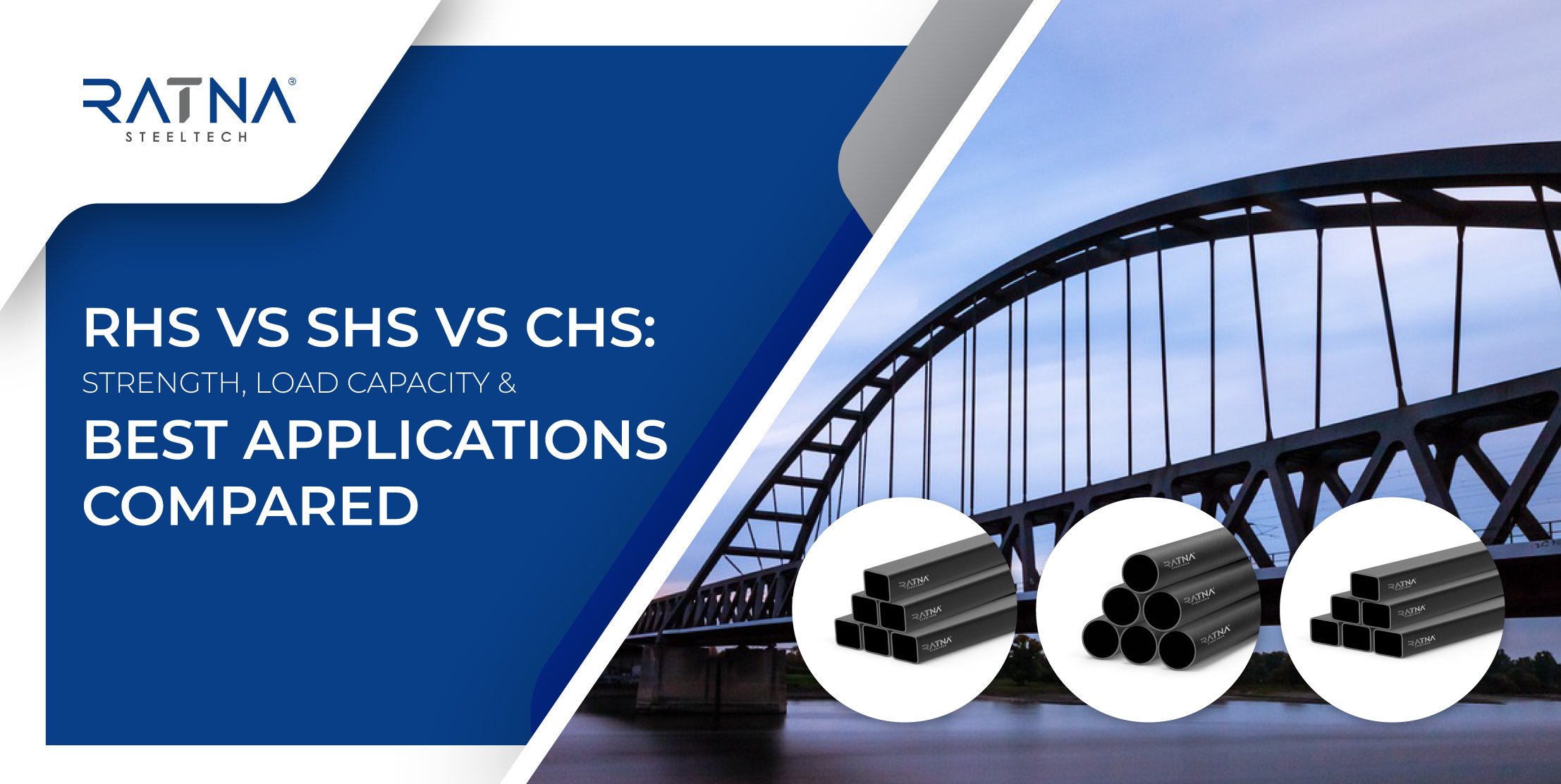
Structural hollow sections are a backbone of modern construction, offering exceptional strength-to-weight ratios and design flexibility across industrial, commercial, and infrastructure projects. Among the most widely used steel hollow sections types are Rectangular Hollow Sections (RHS), Square Hollow Sections (SHS) and Circular Hollow Sections (CHS). Each profile brings unique strengths, structural advantages and application benefits depending on load conditions, architectural requirements and project environments.
For contractors, builders, engineers, fabricators, and industry professionals across solar, oil & gas, agriculture, water treatment, and chemical processing, selecting the right hollow section directly impacts safety, performance and overall project cost-efficiency.
This blog provides a detailed RHS vs SHS vs CHS comparison to help you choose the best hollow section for your construction and engineering needs.
1. Understanding RHS, SHS and CHS: A Clear Overview
Rectangular Hollow Section (RHS)
An RHS features a rectangular profile with varying width-to-height ratios. It is widely used for applications where flat surfaces, aesthetic lines and directional strength are important.
An SHS has equal width and height, offering uniform structural behaviour across axes. It is preferred in architectural frameworks, modular structures and load-bearing assemblies.
A CHS comes with a uniform circular profile that performs exceptionally well in multi-directional load conditions. Its geometry offers superior torsional resistance and visual uniformity.
These three profiles form the fundamental steel hollow sections types used across modern infrastructure and industrial setups.
2. RHS vs SHS vs CHS Strength Comparison
RHS Strength
RHS offers excellent bending resistance due to its flat surfaces and longer moment arm. The structure performs exceptionally under vertical loads, making it suitable for beams, trusses, and heavy frameworks.
SHS Strength
SHS provides balanced axial strength, offering uniform load distribution across both directions. Its symmetrical profile supports efficient column design in multi-storey and industrial structures.
CHS Strength
CHS has the highest torsional strength among hollow sections. Its circular geometry naturally resists twisting forces under dynamic loads, wind pressures and rotational stress – useful for offshore and industrial applications.
When comparing RHS SHS CHS strength, each type excels in different structural scenarios, making selection dependent on the required load path and design intent.
3. Hollow Section Load Capacity: How They Perform Under Real-World Loads
Choosing the right hollow section requires understanding how each profile responds to compressive, tensile and bending loads.
RHS Load Capacity
- Superior performance in one-directional loading
- Ideal for long spans
- High bending and buckling resistance
- Easy to connect due to flat sides
SHS Load Capacity
- High compression capacity
- Symmetry reduces risk of buckling in columns
- Stable and predictable performance under axial loads
CHS Load Capacity
- Excellent behaviour under multi-axial stresses
- Highest resistance to wind-induced forces
- Efficient for structures involving rotation or cyclic loading
Across the hollow section load capacity comparison, RHS leads in bending, SHS excels in compression, and CHS dominates in torsional resistance.
4. RHS vs SHS vs CHS Difference: Detailed Comparison Table
| Parameter | RHS | SHS | CHS |
| Shape | Rectangular | Square | Circular |
| Strength | Best for bending | Balanced axial strength | Highest torsional resistance |
| Load Capacity | Strong in one direction | Strong in both directions | Strong in all directions |
| Connectability | Excellent (flat sides) | Excellent (flat sides) | Moderate |
| Aesthetics | Sleek, directional look | Clean, symmetrical | Smooth, tubular |
| Best Use | Beams, frames, platforms | Columns, modular structures | Towers, pipelines, trusses |
This hollow sections comparison shows that each type offers distinct performance traits suited to specific structural and industrial environments.
5. Structural Hollow Sections Uses: Best Applications for Each
Where RHS Works Best
- Industrial shed beams
- Pre-engineered building frames
- Mezzanine structures
- Heavy-duty racks
- Solar power mounting frames
- Equipment platforms
Its long-span capability and directional strength make RHS the best hollow section for construction requiring strong bending performance.
Where SHS Works Best
- Column structures
- Frames for commercial and residential buildings
- Architectural and modular construction
- Signage poles
- Fabrication-heavy components
SHS offers uniformity and stability, ideal for balanced load-bearing tasks.
Where CHS Works Best
- Oil & gas pipelines
- Water transmission systems
- Agricultural irrigation networks
- Offshore and coastal structures
- Towers, trusses, and wind-loaded frameworks
- Chemical processing applications
With unmatched torsional strength, CHS is preferred for demanding industrial environments and dynamic load conditions.
6. Choosing the Best Hollow Section for Construction Projects
When selecting the right structural profile, consider:
- Type of loads (bending, compression, torsion)
- Span requirements
- Environmental conditions
- Fabrication needs
- Connection details
- Architectural preferences
For example:
- If your project demands long-span beams, RHS is ideal.
- For columns or symmetrical load patterns, SHS is preferred.
- For wind, pressure or rotational forces, CHS remains the strongest choice.
Contractors, engineers and fabricators can significantly improve performance, safety and cost-efficiency by selecting profiles based on real structural behaviour, not assumptions.
Why Choose Ratna Steeltech for Hollow Sections?
Ratna Steeltech manufactures high-precision RHS, SHS and CHS with a commitment to strength, dimensional accuracy and long-term reliability. With advanced manufacturing capabilities, industry certifications and a customer-first approach, we support projects across solar infrastructure, industrial plants, agriculture, oil & gas, and construction.
Our hollow sections are engineered to deliver consistent performance and durability in challenging environments.
Conclusion
The RHS vs SHS vs CHS difference lies in how each hollow section behaves under specific loads and structural conditions. While RHS offers superior bending strength, SHS delivers balanced axial strength and CHS provides unmatched torsional resistance. Understanding these distinctions helps industry professionals choose the most effective and cost-efficient structural solution.For high-quality hollow sections that meet stringent performance standards, Ratna Steeltech is your trusted partner.