

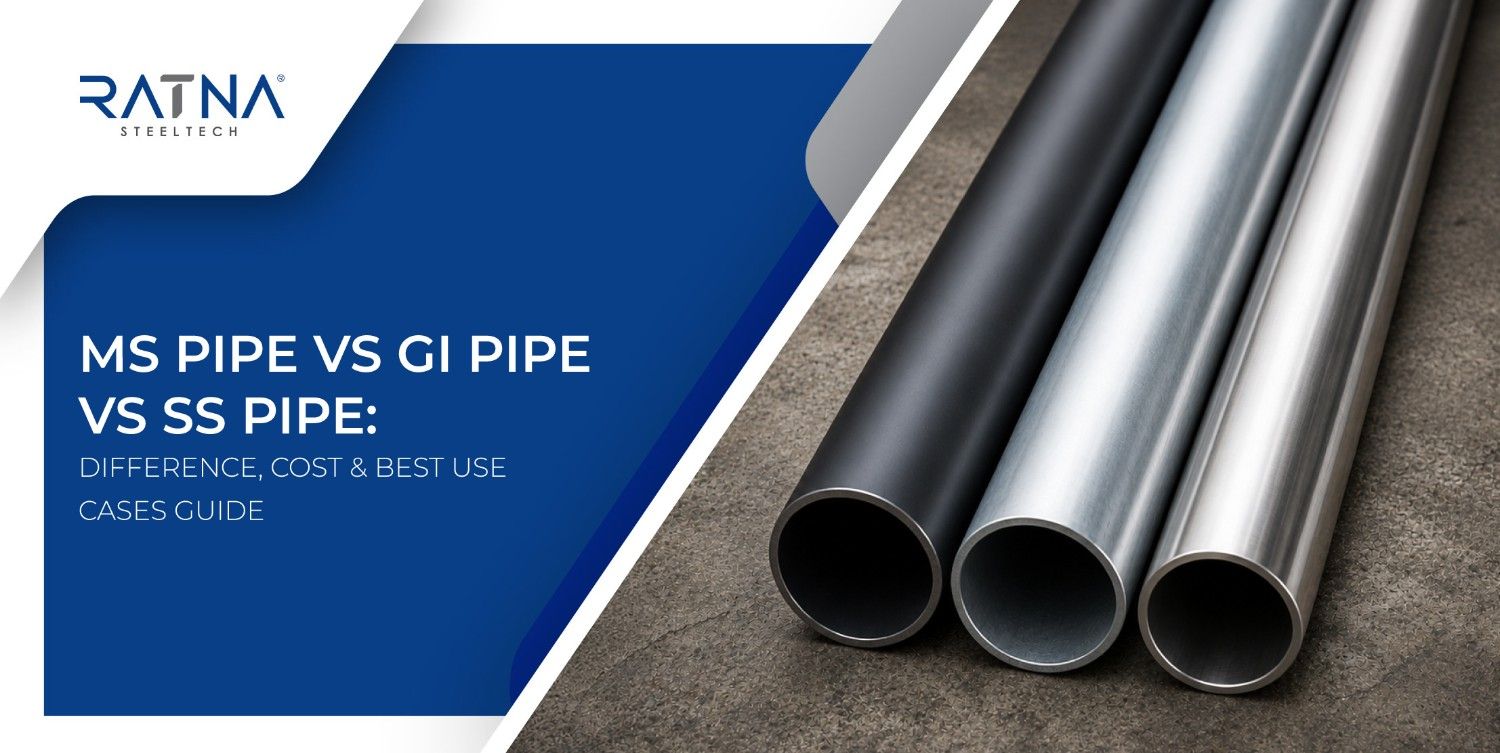
Selecting the right pipe material is a critical decision in construction, industrial infrastructure, plumbing, fabrication, and utility systems. The choice directly impacts performance, durability, maintenance requirements, and overall project cost. Explore the differences between MS, GI, and SS pipes with expert guidance from Ratna Steeltech to make an informed industrial decision.
Among the most widely used options are Mild Steel (MS) pipes, Galvanized Iron (GI) pipes, and Stainless Steel (SS) pipes. A clear understanding of their differences helps engineers, contractors, and procurement professionals choose the most appropriate material based on application needs and environmental conditions.
This guide provides a structured comparison of MS, GI, and SS pipes in terms of composition, performance, cost, and applications.
Overview of MS, GI, and SS Pipes
MS (Mild Steel) Pipes
MS pipes are manufactured from low-carbon steel and are widely used in structural and fabrication applications. They are known for their high strength, ease of welding, and cost-effectiveness.
Common applications:
- Structural frameworks
- Industrial sheds and fabrication works
- Machinery support structures
- General engineering applications
However, MS pipes are susceptible to corrosion and typically require protective coatings when used in moisture-prone environments.
GI (Galvanized Iron) Pipe
GI pipes are steel pipes coated with a layer of zinc through the galvanization process, which enhances their resistance to rust and corrosion.
Common applications:
- Water distribution systems
- Outdoor plumbing networks
- Agricultural pipelines
- General utility infrastructure
GI pipes offer better corrosion resistance than MS pipes but have limitations in heavy fabrication and high-load structural applications.
SS (Stainless Steel) Pipes
SS pipes are manufactured using stainless steel alloys containing chromium, which forms a protective layer that prevents corrosion and enhances durability.
Common applications:
- Food and beverage processing
- Pharmaceutical and chemical industries
- Marine and coastal environments
- High-corrosion or hygiene-critical systems
SS pipes offer superior durability and longevity but come at a significantly higher cost.
MS Pipe vs GI Pipe: Key Differences
The primary distinction between MS and GI pipes lies in corrosion resistance and application suitability.
- MS Pipes: Best suited for structural and fabrication work where strength and cost efficiency are priorities. They require coatings or painting for corrosion protection.
- GI Pipes: Provide enhanced corrosion resistance due to zinc coating, making them suitable for water and outdoor applications.
Cost perspective: GI pipes are generally more expensive than MS pipes due to the galvanization process.
MS Pipe vs SS Pipe: Performance Comparison
The MS vs SS comparison highlights a balance between affordability and performance.
- MS Pipes: Preferred for structural applications where fabrication flexibility and low cost are essential.
- SS Pipes: Designed for environments requiring high corrosion resistance, hygiene, and long service life.
SS pipes are significantly more expensive but deliver superior performance in chemically aggressive or moisture-rich environments.
Corrosion Resistance Comparison
Corrosion resistance is a key factor in material selection:
- MS Pipes: Prone to rust without protective coatings
- GI Pipes: Moderate corrosion resistance due to zinc coating
- SS Pipes: Excellent corrosion resistance due to chromium-rich passive layer
SS pipes offer the highest level of protection in demanding environments.
Strength and Fabrication Considerations
- MS Pipes: High strength and excellent weldability; widely used in fabrication and construction
- GI Pipes: Similar strength to MS pipes but require careful handling during welding due to zinc coating
- SS Pipes: Strong and durable but require specialized fabrication processes
MS pipes remain the most practical choice for large-scale structural fabrication due to ease of processing and cost advantage.
Cost Comparison
- MS Pipes: Most economical option
- GI Pipes: Moderately priced due to galvanization
- SS Pipes: Highest cost due to alloy composition and manufacturing complexity
While SS pipes offer long-term durability, MS and GI pipes are often preferred for budget-sensitive projects.
Best Use Cases Summary
MS Pipes
- Structural frameworks
- Industrial fabrication
- Construction infrastructure
- Heavy engineering applications
GI Pipes
- Water supply systems
- Agricultural irrigation
- Outdoor plumbing
- Utility pipelines
SS Pipes
- Food and pharmaceutical industries
- Chemical processing plants
- Marine and coastal installations
- High-corrosion environments
Conclusion
The choice between MS, GI, and SS pipes depends on a balance of strength requirements, environmental conditions, corrosion resistance, and budget.
- MS pipes offer strength and cost efficiency for structural applications
- GI pipes provide improved corrosion resistance for utility systems
- SS pipes deliver premium performance in highly corrosive and hygienic environments
Selecting the right material ensures long-term performance, reduced maintenance costs, and improved system reliability.
Reliable Pipe SolutionsChoose precision-engineered MS pipe solutions from Ratna Steeltech for reliable performance across structural, industrial, and fabrication applications.
FAQs
What is the main difference between MS, GI, and SS pipes?
MS pipes are economical and widely used for structural applications, GI pipes are galvanized for corrosion resistance, and SS pipes offer premium corrosion resistance with higher durability for specialised industrial use.
Which pipe is more affordable: MS, GI, or SS?
MS pipes are generally the most cost-effective, GI pipes cost slightly more due to zinc coating, while SS pipes are the most expensive because of superior corrosion resistance and alloy composition.
Why do industrial buyers choose Ratna Steeltech?
Ratna Steeltech delivers precision-engineered MS ERW pipes with advanced quality control, dimensional accuracy, and dependable performance for structural and industrial applications.
How do you choose the right MS pipe size?
Pipe size selection depends on load-bearing needs, project specifications, wall thickness requirements, and intended structural application.
What is the difference between ERW pipes and seamless MS pipes?
ERW pipes are manufactured by rolling and electrically welding mild steel sheets, making them cost-effective and widely used for structural applications. Seamless MS pipes are produced without welding joints, offering higher pressure resistance for specialised industrial uses.
Which is better: MS or SS pipe?
The better choice depends on your application needs. MS pipes are more cost-effective, easy to fabricate, and ideal for structural and construction projects, while SS pipes offer superior corrosion resistance, durability, and hygiene fo