

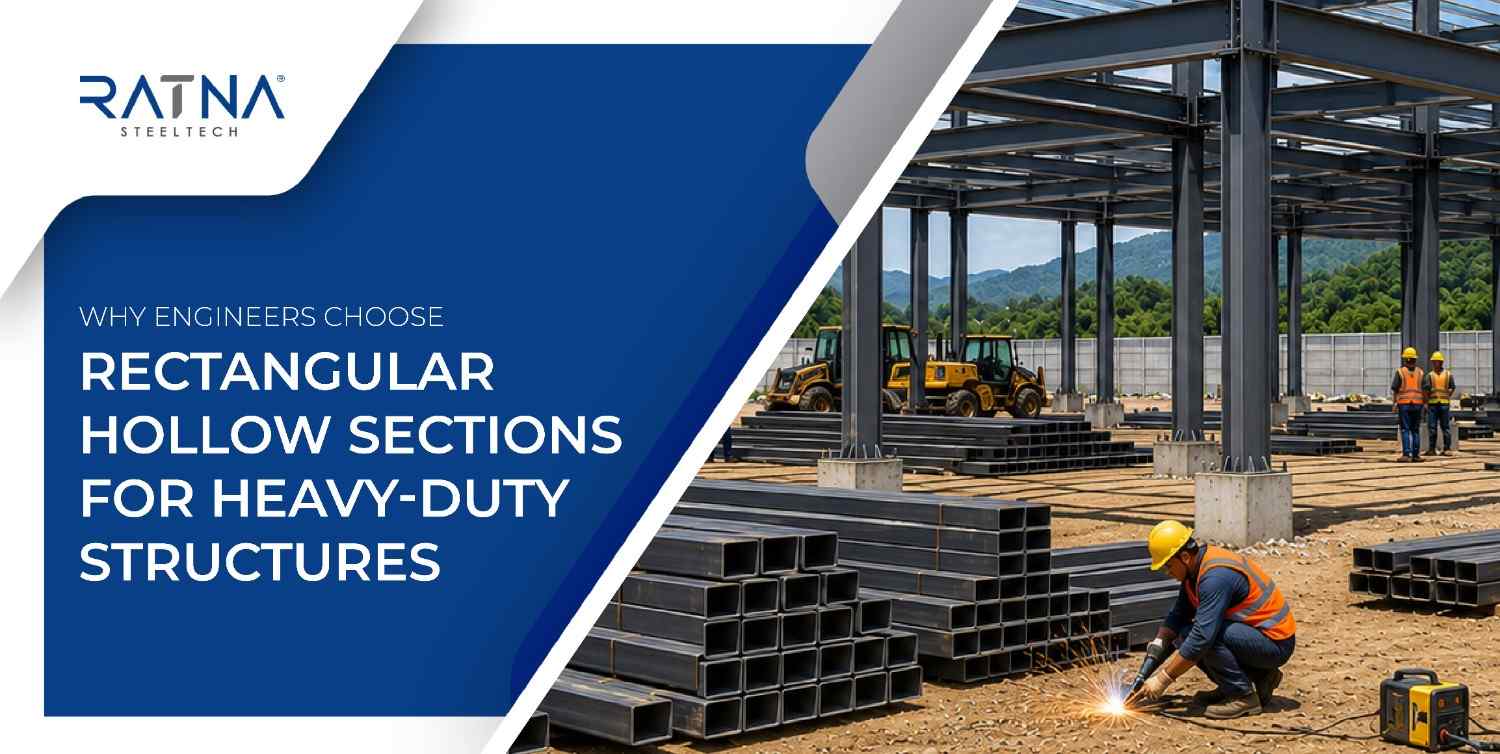
Heavy-duty structures demand materials that can withstand extreme loads, resist environmental challenges, and deliver long-term structural stability. From industrial facilities and warehouses to bridges, equipment platforms, and pre-engineered buildings, selecting the right structural steel section plays a crucial role in ensuring safety, durability, and cost efficiency.
Among the various structural steel solutions available today, Rectangular Hollow Sections (RHS) have become a preferred choice for engineers due to their exceptional combination of strength, structural efficiency, and design flexibility.
With a closed-section profile, excellent load-bearing capability, and efficient material utilisation, RHS provides reliable performance in demanding construction environments. This article explores why Rectangular Hollow Sections in Structural Engineering are widely used for heavy-duty applications and what makes them an ideal choice for modern infrastructure projects.
What Are Rectangular Hollow Sections (RHS)?
Rectangular Hollow Sections (RHS) are structural steel sections featuring a hollow rectangular cross-section. They are manufactured through advanced forming and high-frequency welding processes to achieve precise dimensions, uniform wall thickness, and consistent quality.
Unlike traditional open structural sections, RHS provides strength across both major axes while maintaining a compact and enclosed profile. This unique geometry enhances structural performance while reducing unnecessary material consumption.
Because of their efficient design, Rectangular Hollow Sections are widely used where engineers require a balance between strength, weight reduction, and ease of fabrication.
Why Engineers Prefer Rectangular Hollow Sections
Modern structural engineering focuses on achieving maximum performance while optimising material usage. Rectangular Hollow Sections support this approach through several key advantages.
1. Excellent Load-Bearing Capacity
One of the primary reasons engineers choose RHS is its ability to withstand significant structural loads.
The rectangular profile distributes forces efficiently throughout the section, allowing it to perform effectively under:
- Compression loads
- Bending forces
- Axial loading conditions
- Dynamic operational stresses
This makes RHS suitable for critical structural applications such as:
- Industrial columns
- Structural frames
- Roof trusses
- Heavy equipment supports
- Building frameworks
Their reliable strength enables engineers to design structures capable of performing safely under demanding conditions.
2. Superior Strength-to-Weight Ratio
Heavy-duty construction does not always require heavier materials. Engineers increasingly focus on lightweight solutions that maintain structural strength while improving efficiency.
Rectangular Hollow Sections provide an excellent strength-to-weight ratio, offering several advantages:
- Reduced dead load on structures
- Easier transportation and handling
- Faster installation processes
- Lower foundation requirements
- Improved construction efficiency
For large-scale industrial projects, these benefits can significantly improve project economics without compromising structural performance.
3. Better Resistance to Torsional Forces
Many industrial and infrastructure structures experience twisting forces due to wind pressure, equipment vibration, uneven loading, or operational movement.
The closed-section design of RHS provides superior torsional resistance compared to many open structural sections. This increased rigidity enhances structural stability and helps improve overall safety.
For applications where resistance against twisting and deformation is essential, Rectangular Hollow Sections in Structural Engineering provide a highly effective solution.
4. Improved Structural Stability
Structural stability is a critical factor in large-span buildings, industrial facilities, and infrastructure projects.
The balanced geometry of RHS allows engineers to develop stable structural systems with improved resistance against local buckling. Their uniform load distribution ensures dependable performance under both static and dynamic conditions.
RHS is particularly valuable in:
- Warehouses
- Manufacturing plants
- Logistics centres
- Airport infrastructure
- Industrial sheds
- Multi-storey steel structures
5. Efficient Space Utilisation and Fabrication
The flat surfaces and compact shape of Rectangular Hollow Sections simplify fabrication and structural connections.
Compared with many alternative steel sections, RHS offers advantages such as:
- Easier welding operations
- Accurate bolted connections
- Simple plate integration
- Better alignment during fabrication
- Cleaner architectural appearance
Their compact geometry also allows efficient use of available space, making them suitable for projects where structural layout optimisation is important.
6. Enhanced Durability and Long-Term Performance
Heavy-duty structures often operate in challenging environments, including industrial zones, outdoor installations, and infrastructure projects.
When manufactured from high-quality steel and protected with suitable surface treatments, Rectangular Hollow Sections offer:
- High structural durability
- Improved corrosion resistance
- Extended service life
- Reduced maintenance requirements
These qualities make RHS a dependable choice for long-term construction investments.
Applications of Rectangular Hollow Sections
The versatility of Rectangular Hollow Sections in Structural Engineering allows them to be used across multiple industries and construction applications.
Common applications include:
- Pre-engineered buildings (PEBs)
- Industrial sheds
- Warehouses
- Commercial structures
- Factory buildings
- Solar mounting structures
- Equipment support frames
- Bridge components
- Material handling systems
- Oil and gas infrastructure
- Agricultural structures
- Water treatment facilities
- Structural fabrication projects
Their adaptability allows engineers and fabricators to implement RHS across diverse project requirements.
Key Factors to Consider When Selecting RHS
Selecting the right Rectangular Hollow Section requires careful evaluation of multiple engineering factors, including:
- Structural load requirements
- Section dimensions
- Wall thickness
- Steel grade
- Span length
- Connection design
- Fabrication requirements
- Applicable design standards
A proper assessment of these parameters ensures structural safety, efficiency, and long-term reliability.
Why Quality Manufacturing Matters
The performance of any structural design depends heavily on the quality of the steel sections used.
Engineers prefer manufacturers that provide:
- Advanced manufacturing technology
- Accurate dimensional control
- High-quality welding processes
- Strict quality inspections
- Compliance with industry standards
- Reliable production capabilities
Consistent manufacturing quality improves fabrication accuracy, ensures better structural fit-up, and supports dependable field performance.
Why Choose Ratna Steeltech for Rectangular Hollow Sections?
Ratna Steeltech manufactures high-quality structural steel products designed to meet the requirements of modern infrastructure, industrial, and commercial construction projects.
With a strong focus on precision manufacturing, consistent quality, and rigorous quality control, Ratna Steeltech delivers structural steel solutions that perform reliably in demanding applications.
Serving engineers, contractors, fabricators, and industrial developers, Ratna Steeltech supports efficient construction practices by providing dependable Rectangular Hollow Sections built for strength, durability, and long-term performance.
Conclusion
The increasing adoption of Rectangular Hollow Sections (RHS) highlights the construction industry’s shift toward stronger, lighter, and more efficient structural solutions.
With excellent load-bearing capacity, superior torsional resistance, high strength-to-weight efficiency, and fabrication advantages, RHS has become an essential component in heavy-duty structures across various industries.
As structural engineering continues to evolve, choosing high-quality Rectangular Hollow Sections from a trusted manufacturer is critical for achieving safe, durable, and cost-effective construction outcomes.
With its commitment to manufacturing excellence and quality-driven solutions, Ratna Steeltech continues to support engineers and builders in creating structures designed for lasting performance.