

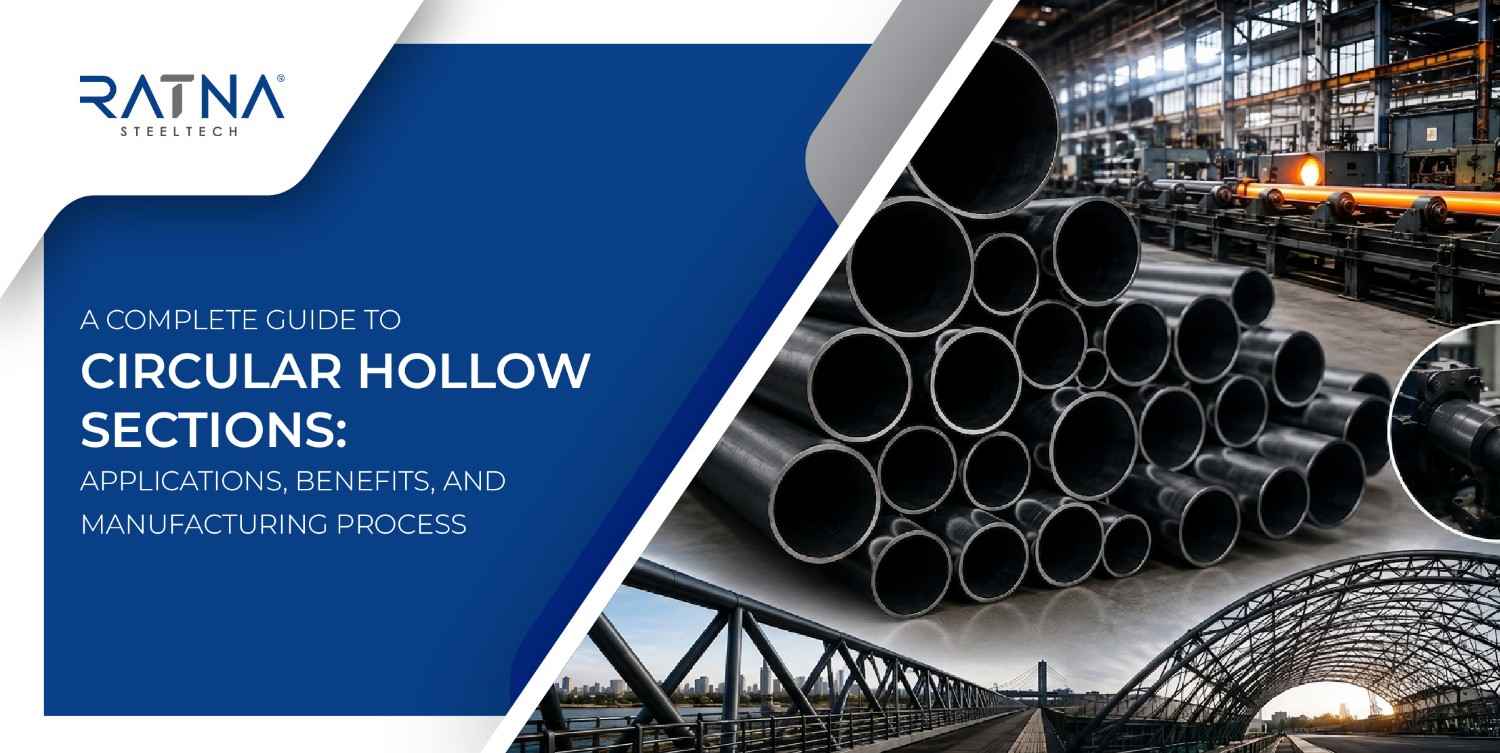
Selecting appropriate structural steel profiles is a critical engineering decision that dictates the load-bearing capacity, longevity, and overall efficiency of commercial and industrial infrastructure. Circular Hollow Sections (CHS) are widely specified across complex engineering projects due to their uniform stress distribution, high strength-to-weight ratio, and exceptional torsional resistance.
Understanding Circular Hollow Sections (CHS)
Unlike standard fluid-conveyance piping designed primarily for containment, Circular Hollow Sections are purpose-engineered structural members manufactured for multi-directional load-bearing applications. Their symmetrical cross-sectional geometry distributes operational stresses—including axial compression, bending moments, and torsional shear—evenly around the perimeter, preventing localized stress concentrations.
The Precision ERW Manufacturing Process
The structural reliability of CHS relies on stringent manufacturing controls and quality assurance standards. Experienced ERW (Electric Resistance Welding) pipe manufacturers execute a controlled five-stage production process:
| Production Stage | Manufacturing Phase | Engineering Significance |
| 1. Material Selection | High-Quality Steel Coils | Verified chemical composition and mechanical properties ensure structural consistency. |
| 2. Cold Forming | Precision Roll-Forming | Flat steel strips are gradually shaped into a uniform circular profile with minimal wall variation. |
| 3. Welding | Electric Resistance Welding | High-frequency ERW creates a continuous longitudinal weld seam without filler materials. |
| 4. Calibration | Sizing & Straightening | Post-weld passes calibrate outer diameter, wall thickness, and axial alignment to tight tolerances. |
| 5. Quality Control | Testing & Inspection | Non-destructive testing and dimensional verification ensure compliance with quality standards. |
Key Engineering & Structural Advantages
- Uniform Stress Distribution: Eliminates weak structural axes, optimizing load-bearing performance in compression members, trusses, and columns.
- High Strength-to-Weight Ratio: Delivers robust load capacity while minimizing dead weight, streamlining transport, crane handling, and field assembly.
- Superior Torsional Rigidity: Provides significantly greater resistance to twisting forces than open steel profiles (such as I-beams, channels, or angles), making CHS ideal for dynamic and wind-exposed structures.
- Enhanced Coating & Maintenance Efficiency: Smooth, closed outer surfaces simplify protective painting or galvanizing while reducing atmospheric corrosion traps.
- Dimensional Versatility: Available in a broad range of outer diameters and wall thicknesses to accommodate lightweight frames or heavy infrastructure load requirements.
Primary Industrial Applications
Circular Hollow Sections provide standardized structural performance across diverse sectors:
- Industrial & Logistics: Pre-Engineered Buildings (PEBs), manufacturing facilities, warehouses, and logistics centers.
- Infrastructure & Energy: Bridges, solar mounting structures, transmission towers, and process plant frameworks.
- Utilities & Processing: Oil and gas piping supports, water treatment plants, and heavy equipment frames.
- Handling & Agriculture: Overhead material handling systems, industrial cranes, and agricultural infrastructure.
Criteria for Evaluating CHS Manufacturing Partners
Selecting a reliable structural steel supplier requires assessing technical capabilities and quality management systems:
- Advanced Manufacturing Infrastructure: Automated forming mills and high-frequency welding lines.
- Quality Assurance Protocols: Comprehensive NDT weld testing, dimensional inspection, and raw material traceability.
- Standards Compliance: Adherence to applicable Indian Standards (IS) and international structural codes.
- Logistics & Regional Delivery: Established distribution networks (e.g., experienced manufacturers in India) that minimize lead times and ensure responsive project support.
Frequently Asked Questions
How do CHS profiles differ from standard steel pipes?
While both share a circular geometry, CHS members are engineered specifically for structural load-bearing capacity, strict dimensional tolerances, and mechanical strength, whereas standard pipes prioritize fluid containment and pressure rating.
Why is ERW preferred for structural CHS production?
Electric Resistance Welding creates a clean, continuous longitudinal bond without adding heavy filler metal, maintaining uniform grain structure, precise dimensions, and cost-effective production.
What advantages do CHS offer in dynamic or wind-exposed environments?
The closed circular profile features a lower drag coefficient against wind forces and high torsional stiffness compared to open steel sections, significantly improving structural stability.
What should engineers check when sourcing CHS components?
Key checks include material test certificates, dimensional tolerances (wall thickness and outer diameter), weld seam integrity, yield/tensile strength properties, and compliance with relevant IS standards.
By combining precision roll-forming with rigorous quality controls, Ratna Steeltech manufactures high-performance Circular Hollow Sections engineered to support demanding industrial and infrastructure applications.