

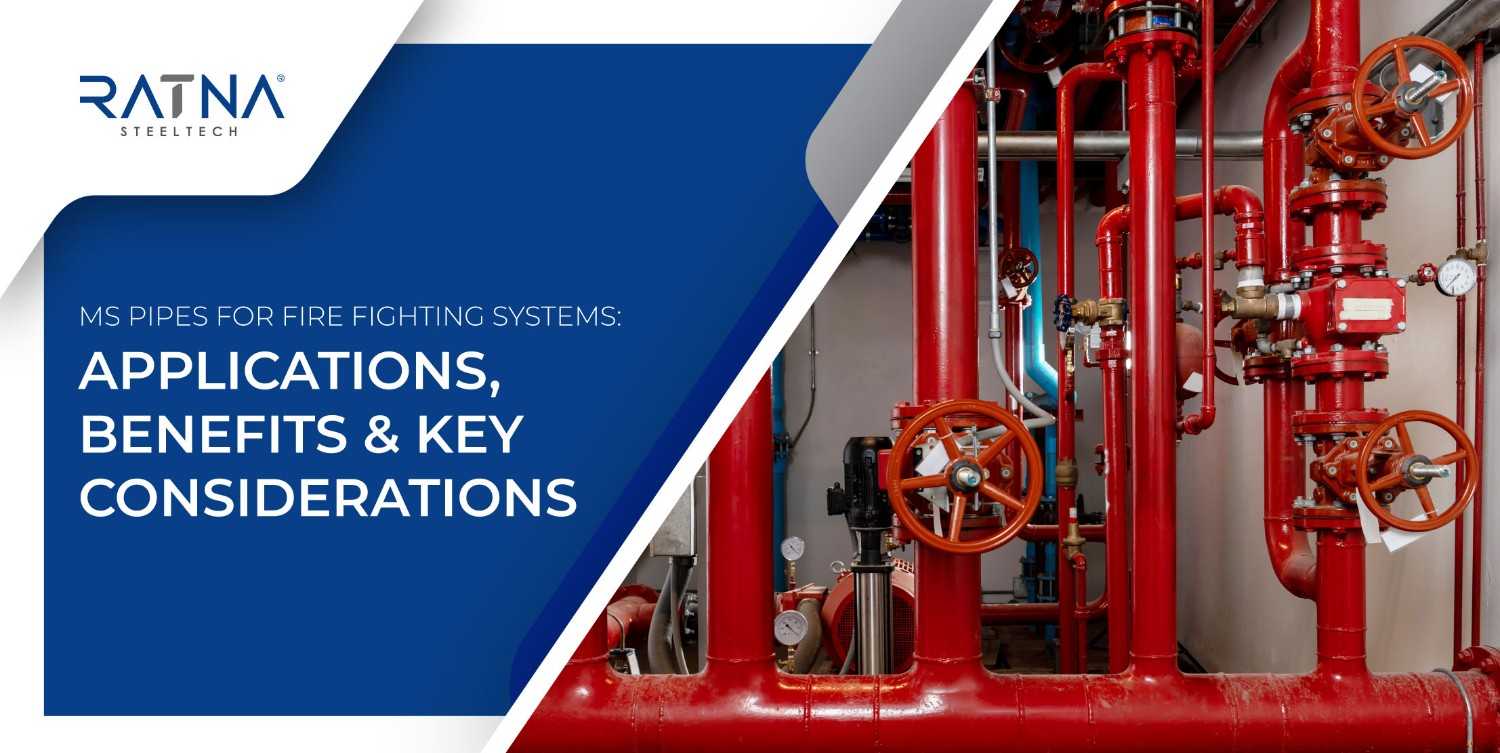
A fire protection system may remain inactive for extended periods, but during an emergency, its piping network must deliver the required volume of water at the specified pressure and flow rate. This makes pipe selection an important engineering, reliability, and safety consideration, rather than simply a routine procurement decision.
MS Pipes for Fire Fighting Systems are widely considered for water-based fire protection networks across industrial, commercial and infrastructure projects. Their mechanical strength, fabrication characteristics, dimensional availability and established manufacturing processes make them suitable for a range of engineered fire-water applications, subject to the requirements of the approved system design.
However, pipe selection should always be based on the applicable standards, project specifications, hydraulic calculations, pressure requirements and approval requirements defined by the fire protection consultant, project authorities and relevant codes.
Where Are MS Pipes Used in Fire Fighting Systems?
Fire protection systems consist of interconnected piping that transports water from a fire-water storage tank, pump system or other approved water source to designated firefighting points.
Depending on the project design, MS piping may be used in applications such as:
- Fire hydrant networks
- Sprinkler systems
- Wet riser and downcomer systems
- Fire-water ring mains
- Fire pump-room piping
- Hose reel systems
- Industrial fire-water distribution networks
The required pipe diameter, wall thickness, material specification, joining method, and routing depend on several engineering parameters, including hydraulic calculations, system pressure, required flow, building configuration, pipe length, elevation, and fire protection system design.
In industrial facilities, pipe routing is another important consideration. Fire-water pipelines may need to pass through production areas, warehouses, process zones, and utility sections while maintaining suitable accessibility for inspection, maintenance, and emergency operation.
Why Are MS ERW Pipes Considered for Fire Protection Applications?
Electric Resistance Welded (ERW) pipes are manufactured by progressively forming steel strip into a cylindrical profile and joining the longitudinal edges using electrical resistance heating and pressure.
When manufactured to the required specification and quality standards, MS ERW pipes can offer several characteristics relevant to engineered fire-water piping applications.
1. Mechanical Strength
Fire-water piping must withstand the operating conditions specified by the system designer. Mild steel provides suitable mechanical properties for many piping applications when the correct material grade, pipe dimensions and wall thickness are selected according to the approved design.
2. Dimensional Consistency
Consistent pipe dimensions are important during fabrication and installation. Controlled outside diameter, wall thickness and overall dimensional accuracy can help contractors achieve better alignment and compatibility with fittings, valves, flanges and other system components.
3. Fabrication Flexibility
Fire protection networks can involve multiple branches, supports, flanges, connections and changes in routing. Steel’s fabrication characteristics make MS ERW pipes practical for many engineered layouts when cutting, welding and joining are carried out in accordance with approved procedures.
4. Availability in Multiple Sizes
Fire protection networks can range from relatively compact commercial systems to extensive industrial fire-water distribution networks.
Different projects require different pipe diameters and specifications. The availability of MS ERW pipes in multiple dimensions allows contractors and project engineers to select products based on the requirements established by the system design.
Key Considerations When Selecting MS Pipes for Fire Fighting Systems
Selecting a fire-fighting pipe based only on nominal diameter or price can create challenges during fabrication, installation and system commissioning.
Project teams should evaluate the complete technical specification before procurement.
1. Applicable Standards and Approvals
The pipe should comply with the standards, specifications, certifications and approvals stipulated in the project documentation and by the relevant authority, consultant or fire protection system designer.
The applicable requirements may vary depending on the building type, jurisdiction, fire protection system and project specifications.
2. Pipe Diameter and Wall Thickness
Pipe diameter and wall thickness should be selected based on the approved hydraulic and structural requirements.
Diameter influences flow characteristics, while wall thickness contributes to the pipe’s mechanical and pressure-related performance. Neither parameter should be selected independently of the overall system design.
3. Material and Manufacturing Quality
Procurement teams should verify:
- Material grade and specification
- Pipe dimensions and tolerances
- Wall thickness consistency
- Weld quality
- Manufacturing controls
- Testing requirements
- Material traceability
- Relevant inspection documentation
Consistent manufacturing quality can help reduce fabrication and installation issues while supporting reliable system performance.
4. Corrosion Protection
Fire-water piping can be exposed to moisture, humidity and other environmental conditions over long periods.
Depending on whether the piping is installed indoors, outdoors, underground or in another environment, the project may require appropriate surface preparation, painting, coating, galvanisation or other corrosion-protection measures.
The selected protection system should be compatible with the project specification and installation environment.
5. Joining and Installation Requirements
Fire protection piping can incorporate different joining arrangements depending on the pipe size, system design and project requirements.
These may include:
- Welded connections
- Grooved connections
- Flanged connections
- Threaded connections, where applicable
The selected pipe must be compatible with the specified joining method, fittings and system components. Installation should always follow approved drawings, procedures and applicable fire protection requirements.
Why Manufacturing Quality Matters in Fire Protection Piping
A fire-fighting network is a safety-critical system, making consistency and reliability particularly important.
Pipe quality can influence fabrication accuracy, joint preparation, connection integrity and the long-term reliability of the piping network.
Consequently, procurement teams should evaluate a manufacturer on more than commercial pricing. Important factors include:
- Manufacturing infrastructure
- Raw-material inspection
- Process controls
- Dimensional inspection
- Weld-quality controls
- Testing practices
- Material traceability
- Production consistency
- Documentation and quality records
- Ability to meet project-specific specifications
Choosing a manufacturer with established quality-control procedures can help contractors and project buyers align material supply with the technical requirements specified for the project.
MS ERW Pipes for Industrial Fire Protection Projects
Industrial fire protection systems can vary significantly depending on the nature and scale of the facility.
A warehouse may require extensive sprinkler and hydrant networks, while manufacturing plants, chemical facilities, processing units and other industrial installations may require larger fire-water distribution systems with dedicated pump rooms, ring mains and multiple discharge points.
For this reason, MS Pipes for Fire Fighting Systems should not be treated as a one-size-fits-all product.
The appropriate pipe specification should be determined in coordination with the fire protection consultant, system designer, project engineer and relevant approving authority.
Ratna Steeltech – MS ERW Pipes and Tubes Manufacturer in Gujarat
Ratna Steeltech manufactures MS ERW Pipes and Tubes at its manufacturing facility in Gujarat, serving requirements across industrial and infrastructure applications.
For contractors, fabricators and project procurement teams, the company focuses on supplying steel tubes according to specified dimensions and project requirements, supported by manufacturing and quality-control processes.
When evaluating MS ERW pipes for a fire protection project, customers can discuss their required sizes, wall thickness, applicable specifications, quantities and project requirements with the Ratna Steeltech team to determine the appropriate product configuration.
Making the Right Choice for Fire Fighting Piping
Selecting piping for a fire protection system requires a balance of technical compliance, manufacturing quality, dimensional consistency, corrosion protection and supply reliability.
MS ERW pipes can be considered for suitable fire-water applications when they meet the requirements of the approved system design and applicable standards.
For contractors, consultants and industrial project owners, the right approach is to begin with the system specification and hydraulic requirements and then select a pipe manufacturer capable of consistently meeting those requirements.
Looking for MS ERW Pipes and Tubes for an industrial or fire protection project?
Share your required pipe sizes, specifications, quantities and project requirements with Ratna Steeltech.
Contact Ratna Steeltech to discuss your MS ERW pipe requirements.
Frequently Asked Questions
Which pipe is commonly used for fire-fighting systems ?
Mild steel pipes are commonly specified for various water-based fire protection applications. The appropriate pipe type, material specification, diameter and wall thickness depend on the approved system design, pressure requirements, applicable standards and project specifications.
Can MS ERW pipes be used for fire-fighting systems?
MS ERW pipes may be used in fire-water applications where they comply with the requirements of the approved fire protection design and applicable standards or project specifications. The required material grade, dimensions, wall thickness, testing and approvals must be established before procurement.
What should be checked when buying MS pipes for fire-fighting systems?
Buyers should evaluate the applicable standards, material grade, pipe diameter, wall thickness, manufacturing quality, dimensional tolerances, testing requirements, material traceability, corrosion protection and compatibility with the specified joining system.
Why is pipe thickness important in fire-fighting systems?
Wall thickness is one of the factors affecting a pipe’s mechanical and pressure-related performance. The required thickness should be determined according to the applicable engineering calculations, system operating conditions, relevant standards and approved project specifications.
How should I select an MS ERW pipe manufacturer?
Evaluate the manufacturer’s production capability, quality-control systems, raw-material controls, dimensional inspection, testing procedures, material traceability, manufacturing consistency, supply capacity and ability to meet the technical requirements of your project.
Are MS ERW pipes suitable for all fire protection applications?
Not necessarily. Suitability depends on the specific fire protection system, applicable standards, project specifications, operating conditions and approval requirements. Pipe selection should therefore be confirmed against the approved design before procurement.